AWS Unveils Enhanced Custom Event Bus for Amazon EventBridge to Revolutionize Enterprise Event-Driven Architecture

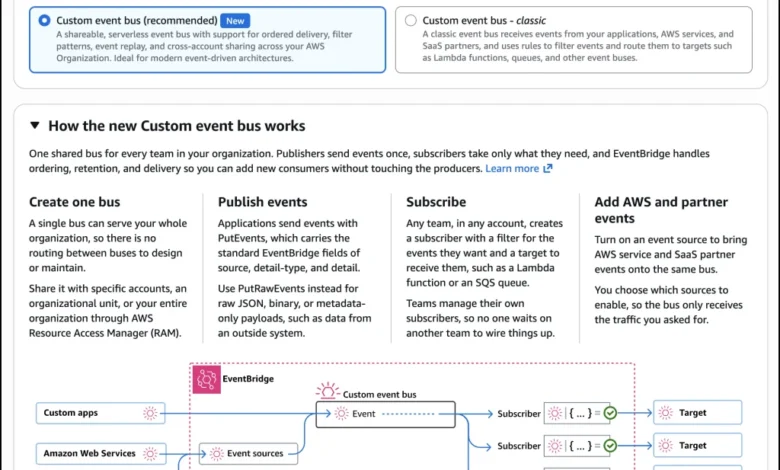
The evolution of cloud-native application development has been marked by a transition toward increasingly granular, event-driven architectures. As organizations shift away from monolithic systems, they have embraced the benefits of decoupling services through event-driven patterns. However, this shift has brought significant operational overhead, particularly for large enterprises managing multi-account environments. Today, Amazon Web Services (AWS) is addressing these complexities with the launch of the enhanced custom event bus for Amazon EventBridge, a foundational update designed to streamline enterprise-scale communication across disparate cloud accounts.
The Evolution of Event-Driven Complexity
The foundational promise of serverless architecture is the abstraction of infrastructure management. Yet, for many organizations, this promise has been partially obscured by the "architectural tax" of managing event routing in multi-account AWS environments. Previously, when teams moved beyond a single-account architecture, they were forced to implement a patchwork of cross-account rules, bus-to-bus configurations, and complex IAM permission sets to facilitate communication.
This operational burden grew exponentially with organizational size. Platform teams found themselves struggling with limited visibility into event lineage, while developers encountered bottlenecks when attempting to coordinate events across team boundaries. Furthermore, legacy constraints—such as the lack of native ordering guarantees—forced engineers to implement custom solutions, often involving additional services like Amazon Simple Queue Service (SQS) to act as a buffer for sequential processing. This not only increased costs but also introduced latent points of failure and increased the total cost of ownership (TCO) for serverless deployments.
Chronology and Development Roadmap
The introduction of the enhanced custom event bus represents the culmination of years of feedback from enterprise customers operating at hyperscale. Historically, Amazon EventBridge evolved from its predecessor, CloudWatch Events, to provide a more robust bus-based architecture. However, the requirement for a "central nervous system" that spans an entire AWS Organization has remained a primary request among cloud architects.

The timeline leading to this release reflects the broader maturity of serverless adoption:
- 2019: Amazon EventBridge is launched, formalizing the event-driven standard for AWS.
- 2021-2023: As multi-account strategies (using AWS Organizations) become the standard, the friction of managing event buses across these accounts becomes a frequent topic in AWS architecture reviews.
- 2024: AWS begins integrating more advanced routing capabilities, such as event replay and archive features, to assist with fault recovery.
- September 2026: AWS officially releases the enhanced custom event bus, addressing the scaling limitations of the "Classic" bus model.
Key Technical Innovations
The new enhanced custom event bus introduces four pillars of functionality that differentiate it from the legacy model: centralized orchestration, strict event ordering, the consolidated "Subscriber" resource, and intelligent payload processing.
1. Centralized Governance via Resource Access Manager (RAM)
The most significant departure from the legacy model is the integration with AWS Resource Access Manager (RAM). Organizations can now create a single, centralized event bus and share it across an entire AWS Organization or specific organizational units. This removes the need for fragmented, account-specific buses, effectively collapsing the infrastructure footprint. By centralizing the bus, platform teams gain a unified control plane, enabling them to monitor cross-team traffic, apply consistent security policies, and maintain visibility into the entire event flow.
2. Native Event Ordering and Synchronous Processing
One of the most persistent challenges in distributed systems is the arrival of events out of sequence. In sectors like logistics, finance, and supply chain management, where event state transitions are time-sensitive, this can lead to severe data corruption. The enhanced bus introduces an EventGroupId mechanism. When events are published with a common identifier, EventBridge enforces a strict delivery order to subscribers opting into this sequence.
Complementing this is the introduction of synchronous invocation. By allowing targets—such as AWS Lambda—to confirm successful processing before the bus acknowledges the event, the system eliminates the "reliability gap" that previously necessitated intermediate SQS queues. This simplifies the architectural diagram, reducing the number of moving parts that require maintenance and monitoring.

3. The Subscriber Resource Model
Under the previous architecture, managing event filtering, retries, and dead-letter queues required the creation and synchronization of multiple disparate rules. The new Subscriber resource serves as a single, immutable unit of configuration. This simplifies the developer experience by consolidating all delivery logic into one location. Furthermore, with a default quota of 10,000 subscribers per bus, organizations can scale their event-driven ecosystems without the fear of hitting artificial limits that previously forced unnecessary architectural fragmentation.
4. Intelligent Payload Transformation and Deduplication
AWS has also addressed the "data impedance mismatch" that often occurs between microservices. The inclusion of JSONata expressions allows for native payload transformation at the bus level. Subscribers can now extract, rename, or compute new values from events on the fly. Additionally, for systems that struggle with exactly-once delivery, the bus offers content-based deduplication. By hashing event payloads and filtering duplicates within a five-minute window, the service provides near-exactly-once semantics, alleviating the need for developers to build manual idempotency logic into every consumer service.
Economic Implications and Cost Structure
The transition to the enhanced custom event bus is accompanied by a shift in the underlying pricing model. In the legacy model, costs could become unpredictable due to the cumulative nature of cross-account routing charges. The new model adopts a simplified ingress and egress throughput approach.
Publishers pay for events ingested, while subscribers pay for the delivery of those events. This "pay-for-what-you-consume" structure offers a more transparent cost allocation method for platform teams, who can now map costs directly to the services and teams generating and consuming traffic. Early analysis suggests that for large-scale organizations, this model will reduce the overhead of managing complex, multi-bus routing, likely resulting in a lower TCO despite the increased feature set.
Industry Impact and Expert Analysis
Industry observers note that this release signifies a shift in AWS’s strategy toward "opinionated infrastructure." By providing a more structured, high-performance bus, AWS is effectively guiding enterprises toward a cleaner, more sustainable event-driven pattern.
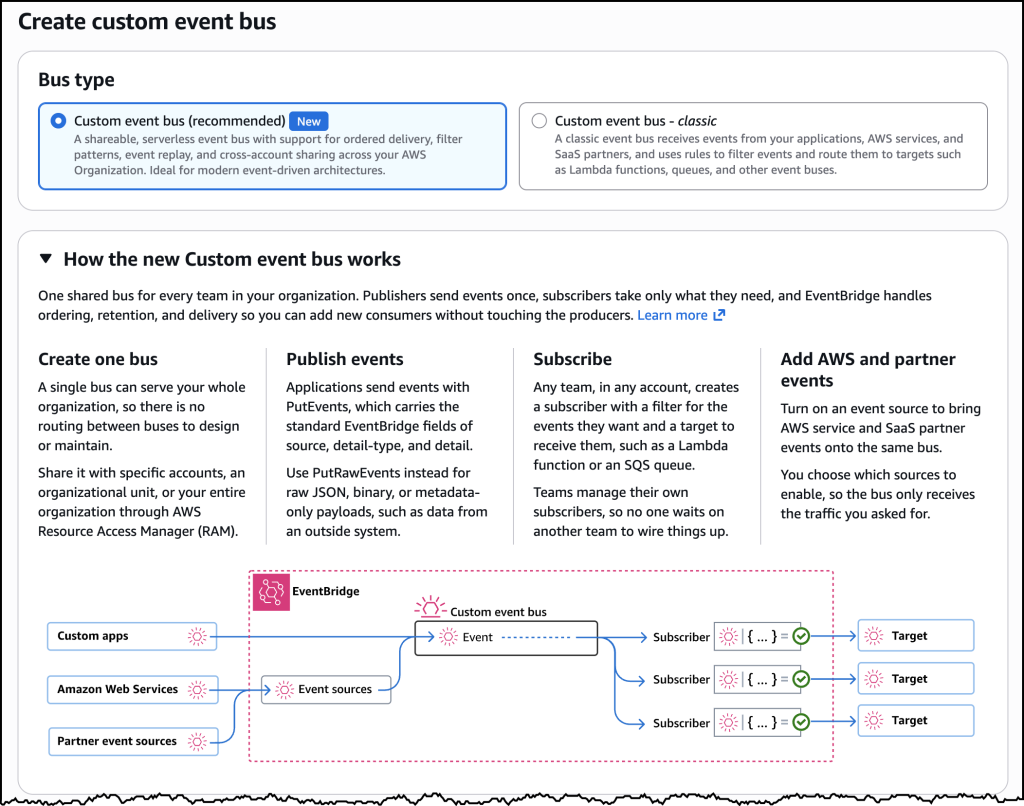
"The shift from the ‘Classic’ bus to the ‘Enhanced’ bus is not just a feature upgrade; it’s a paradigm shift," notes one cloud architecture analyst. "By removing the technical debt associated with cross-account routing, AWS is allowing developers to focus on business logic rather than the plumbing of distributed systems. The ability to handle ordering natively without SQS is a game-changer for high-throughput, sequential processing workloads."
Availability and Adoption
The enhanced custom event bus is currently available in key AWS regions, including US East (N. Virginia, Ohio), US West (Oregon), and a range of European and Asia-Pacific regions. AWS has emphasized that this is an opt-in migration; the "Classic" bus remains fully supported for existing workloads, allowing teams to transition at their own pace.
For organizations currently struggling with the "spaghetti" of cross-account EventBridge rules, the enhanced bus provides a clear path forward. By providing a unified backbone that respects the security and governance requirements of large enterprises, AWS has effectively lowered the barrier to entry for complex, event-driven, multi-account cloud deployments. As organizations continue to migrate to serverless, the ability to manage, order, and securely share events through a centralized bus will likely become the industry standard for robust, enterprise-grade cloud applications.